

In the previous Intelligence Of Rottweiler we announced the topic: How Rottweilers Learn. Classical learning and instrumental learning are two important concepts central to Rottweiler training. Both types change Rottweiler’s behavior, but they differ in important ways and each of these techniques is used at the appropriate age of the Rottweiler.
Classical learning does not change a Rottweiler’s conscious behavior but rather the dog’s physiological responses to specific stimuli. Consequently, this technique corresponds to basic training and is applied from the 15th day of a puppy’s life.
On the other hand, instrumental learning is a form of training that creates new and more complex forms of behavior. This technique alters Rottweiler’s conscious behavior based on learned associations of the behavior with consequences that follow it.
Therefore, classical conditioning is a process that precedes training and is called paving the way for further learning through instrumental conditioning.
To understand how each of these behavior modification techniques can be used, it is essential to understand how classical and instrumental conditioning differ from one another.
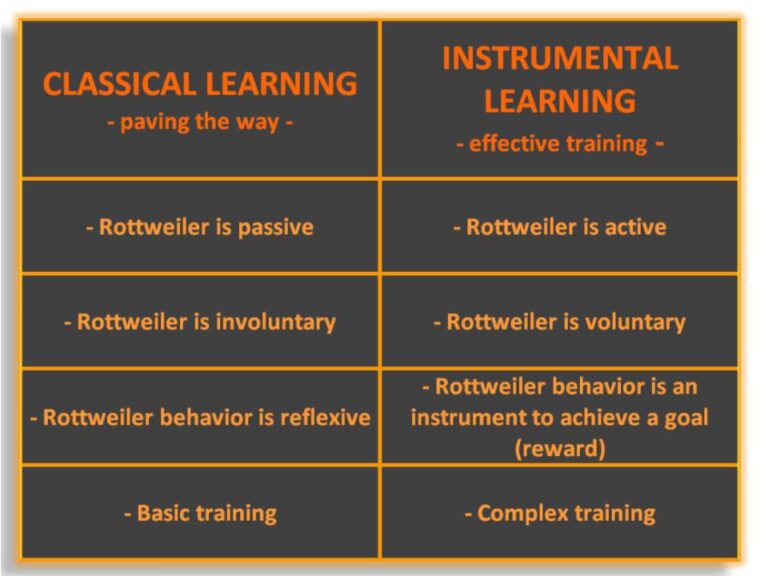
While classical learning is useful in basic training (pupyhood), instrumental learning hold far greater importance in complex technique of Rottweiler training. That’s why we reminded here about classical conditioning, which was the topic of our blog When, Why and How to Start Training a Rottweiler, and in the following text we will deal with instrumental learning, as a way of complex training of Rottweilers.
INSTRUMENTAL LEARNING
Why is it called instrumental?
– Because the Rottweiler uses his behavior as an instrument to reach his goal.
Why do Rottweilers use this method?
– Instrumental learning is an innate trait of dogs and occurs naturally.
In order to understand their physical environment, animals must physically interact with it. Therefore, as we have said, they use their behavior as a communication tool necessary to achieve the desired goal.
How do Rottweilers do it?
– By trials and errors (spontaneously).
When instrumental learning occurs naturally, trials and error is a problem-solving method where different solutions are tested repeatedly until a successful one is found. This process involves trying a method, and if it fails, discarding the method and trying a new one, continuing until the correct solution is achieved. That is how Rottweilers acquire the range of learned behaviors they exhibit every day. It is instrumental learning, but it is not training. For instance, many dogs will spontaneously learn to open the door of the house to go out into the yard.
– By rewards (training).
Effective training is based on the Rottweiler’s natural need to understand their environment, but instead of trial and error methods, the trainer introduces reinforcement of desired behavior.
This technique aims to increase helpful behaviors while decreasing harmful ones through a system of rewards that encourage positive changes. When a Rottweiler completes a task correctly or reaches a specific goal, he receive a reward, reinforcing the desired behavior and making it more likely to occur again.
The general principle of instrumental learning training is easy to understand, but the practical application of rewards requires special skills. Careful control of consequences that shape desirable dog behaviors is key and is implemented by rewarding on appropriate schedules.
REWARD SCHEDULES
Understanding these schedules is crucial in Rottweiler training as they shape voluntary behaviors based on anticipated outcomes
It is all about: Reward – “when” and “how often”.
Why are schedules and their rules vital?
– Because the correct use of the reward schedule reinforces the desired behavior, while incorrect use leads to stagnation and extinction of the learned behavior. Understanding and using schedules of rewarding in Rottweiler training is key to shaping desired behaviors and maximizing dog progress.
When we train a Rottweiler, our goal is to perfect his skills and make them become the rule of his behavior.
The consequence of an incorrect reward schedule is the extinction of learned skills. In this case, the Rottweiler cannot develop complex forms of behavior.
Let’s see what extinction of learned behavior actually is.
EXTINCTION
Extinction occurs if a Rottweiler becomes desensitized to rewards.
Extinction refers to the gradual decrease and possible elimination of a learned behavior. Despite the dog is receiving a reward, decreased motivation and engagement.
But why does it happen? We rewarded the dog, didn’t we?
– Yes, but we didn’t follow the basic rules of the reward schedule, and the dog just wasn’t motivated anymore.
When a Rottweiler is rewarded every single time they perform a desired behavior, they quickly learn a strong association between the behavior and the reward. When the reward is suddenly removed (extinction begins), the dog rapidly detects this change and stops performing the behavior because he immediately realize the expected outcome is no longer available.
In that situation, it is not possible to form a complex dog behavior (variety of complex training consisting of a series of individual skills combined into a whole). The dog will build a strong exclusive association with the new behavior, and will not show the previously learned one.
What is the secret?
– A learned skill maintained by constant, predictable rewards is less persistent when those rewards are removed. This is because the absence of the reward is easily discriminated, leading to a rapid decline in the behavior. In contrast, unpredictable, intermittent rewards create a more durable behavior that is difficult to extinguish.
Now that we know what not to do and why, let’s move on to the correct use of reward schedules.
TYPES OF REWARD SCHEDULES
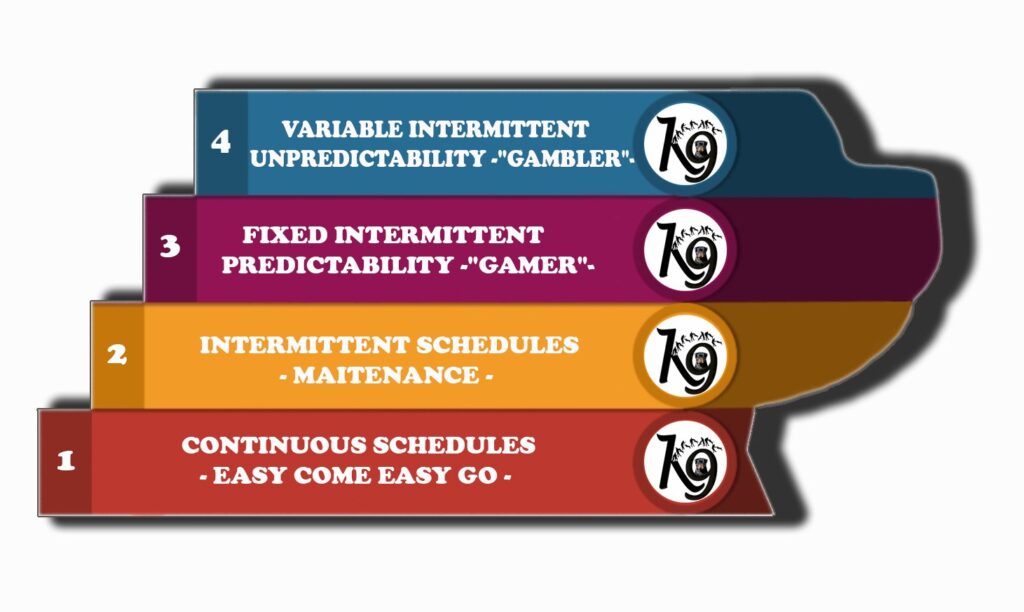
Understanding the types, rules and order of application these schedules can dramatically impact the strength and rate of the Rottweiler learning.
Why timing matters?
– Rewarding is not a straightforward process, and there are a number of factors that can influence how quickly and how well new things are learned. When and how often behaviors were rewarded plays a role in the speed and strength of learning.
In other words, the timing and frequency of rewarding influence how new behaviors are learned and how old behaviors are modified.
What is the goal?
– Behaviors that are very well established will become impervious to extinction and may continue to be displayed even after the rewarding has been removed altogether.
The two foundational forms of reward schedules are referred to as continuous rewarding and intermittent rew
1. CONTINUOUS SCHEDULES
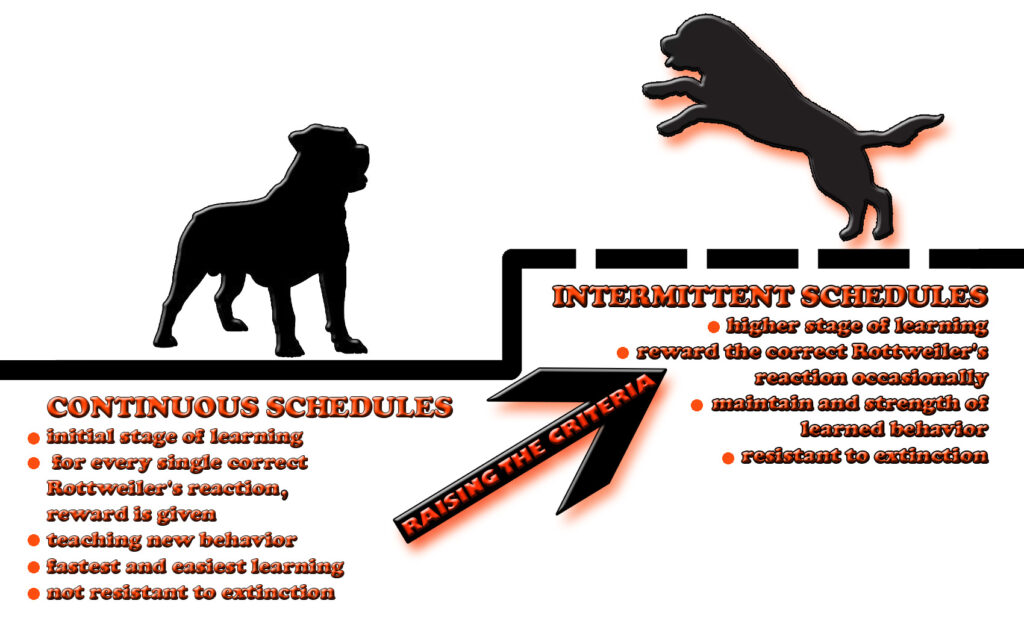
Goal: learning a new behavior.
Strenght level: easy come easy go.

Example: learning Rottweiler to sit. Each time he sits, you give him a treat. Timing is important here-you will be most successful if you present the reward immediately after he sits, so that he can make an association between the target behavior (sitting) and the consequence (getting a treat).
In continuous schedules, reward is provided every single time after the desired behavior. This schedule is best used during the initial stages of Rottweiler learning.
Due to the behavior being rewarded every time, the association is easy to make, and learning occurs quickly. However, this also means that extinction occurs quickly after rewarded is no longer provided.
This reinforcement schedule is the quickest way to teach Rottweiler a behavior, and it is especially effective in learning a new behavior.
Why Rottweiler behavior learned at this stage is still not a skill?
-Because skills are retained permanently or relatively easily renewed, while what is learned only superficially or partially is forgotten.
In this phase, Rottweiler’s behavior is formed by continuous reward. If we stick to a continuous reward schedule, the dog would perform the learned exercise only while we reward it after each action (sitting). Without a reward, the dog stops behaving in the desired way. This excludes the possibility of adopting a complex behavior, because the dog does not connect a series of exercises as a whole, but only adopts one behavior and that momentarily, while such behavior is rewarded.
Human fact: We can understand the concept of continuous schedule even better through human behavior. An example can be a candy machine. Every time we put money in, we receive candy in return. However, if a candy machine were to fail to provide candy twice in a row (let’s say it broke), we would likely stop trying to put money in. We have come to expect our behavior to be rewarded every time it is performed and quickly grow discouraged if it is not.
Why is this just the first step in learning a Rottweiler?
-While continuous
Solution: We have to move to what is called intermittent schedule.
2. INTERMITTENT SCHEDULE
Goal: maintenance of learned behavior.
Strength level: behavior that is resistant to extinction.

This is a gradually raising the criteria in learning a Rottweiler.
Once a behavior has been established, it is necessary to transition to a intermittent reward schedule. Unlike continuous schedules, partial schedules only rewards the desired behavior occasionally rather than all the time.This is based on the number of correct Rottweiler responses that have occurred.
Intermittent reward schedule have proven to be effective in ensuring the behavior is sustained. It has a better effect in maintaining or increasing the frequency or intensity of the dog’s previously learned response.
Why is that so?
– Because of Predator Success Rates.
At first glance, this technique looks like a paradox: less reward – more stable behavior.
But, in natural conditions, it is rare that every emitted reaction of an animal is rewarded. Because of that, behaving efficiently is central to animals’ adaptation to their environment. Optimal behavioral strategies are genetically inherited, yet the behaviour of many animals depends crucially on learning.
Therefore, this method encourages the Rottweiler’s natural need to create optimal conditions for achieving the goal (reward) by applying already learned behavior. In other words, intermittent schedule develops the patience and the ability to wait for a reward.
If a Rottweiler is rewarded every time under controlled conditions (training) it exhibits the specified behavior, the dog will react strongly to the first instance of it not being rewarded and is unlikely to continue exhibiting the behavior.
How it works?
– Rottweiler is tempted to persist in their behavior in hopes that they will eventually be rewarded.
There are two types of intermittent schedules for Rottweiler learning: fixed and variable, and each one has a different effect on behavior. Let’s delve into the definition and explanation of these two types of intermittent, along with some examples of its application in Rottweiler learning.
a) Fixed schedules
Goal: set-consistent number of correct reaction.
Example: After the Rottweiler shows desirable behavior to the command “sit” three times, a reward is delivered.

Fixed schedules are used after a command has been learned but to reinforce it. In our example, the Rottweiler has learned that sitting earns a reward. To make sure the dog continues this behavior, it must be reinforced with a fixed reward schedule.
What exactly does “fixed schedule” mean?
– In this schedule, reward is given after the completion of a number of dog responses to our command. The required number of responses remains constant (fixed).
How it works?
– Predicable number of reaction- predictability of the rewards.
The fixed schedules is predictable for Rottweiler. This method is a very effective way to maintain a high degree of responsiveness of the dog, because the reward directly depends on the number of correctly performed reactions to the command.
Human fact: We can understand the concept of continuous schedule even better through human behavior.
– A video game rewards 1 token for every 5 obstacles that are overcame by the player. This system encourages players to continue overcoming obstacles to earn tokens. The fixed ratio of 5 overcoming to 1 token creates a predictable reward pattern, motivating ongoing gameplay.
Why we should go to next level of Rottweiler learning?
– This high rate of reactions is one of the advantages of a fixed schedule. One possible disadvantage is that Rottweilers may quickly become exhausted from such a high response rate. Or, they may become satiated after several reinforcements have been given.
b) Variable schedules
Goal: Engagement in desired behavior even after the dog is not being rewarded for it.
Example: For our Rottweiler, who already knows to sit on command, the reward will come after two reactions, then five reactions, then three reactions, and so on.

Variable schedules are used after the command has been learned and the Rottweiler’s patience has been developed with a fixed schedule. This is similar to a fixed schedule, but rewards are given after a somewhat random number of responses on command.
What exactly does “variable schedule” mean?
– In this schedule, Rottweiler receives the reward after a varied number of responses on our command.
How it works?
– Rewards are provided after an unpredictable number of responses. There is no predictability as to when a reward will be received. It might be after the first response or the fifth, or another number entirely.
The unpredictability of rewarding keeps the Rottweiler engaged and motivated to continue displaying the desired behavior. In other words, the dog is motivated to repeats desirable behavior to maximize chances of getting reward.
To better understand how variable schedules are applied in Rottweiler learning, let’s consider first an interesting fact: When it comes from humans, the variable reward schedules have one potential drawback is that it can lead to addictive behaviors, as seen in gambling addiction.
For instance, slot machines at casinos operate on partial schedules. They provide money (reward) after an unpredictable number of plays (behavior). Players have no way of knowing how many times they must play before they win. All they know is that, eventually, a play will win. This is why slot machines are so effective and players are often reluctant to quit. There is always the possibility that the next coin they put in will be the winning one.
Now imagine a Rottweiler training with the passion of a gambler!
But don’t worry – in dogs, these reward schedules develop exclusively positive traits. A dramatic example serves to illustrate the Rottweiler’s willpower to learn useful and desirable skills. It is technique in which an Rottweiler voluntarily (without coercion or punishment) changes its actions due to the administration of rewards for those actions.
This method encourages consistent and persistent behavior. It means that the variable schedules promote generalization, enabling Rottweilers to apply the learned behavior in various settings and with different people.
Generalization is a cornerstone of Rottweiler learning as it enables dog to transfer learned behaviors across different environments. The goal is not just to master a skill but to apply it in various settings. Successful generalization fosters adaptability and independence, crucial for socialization and daily functioning.
CONCLUSION
In Rottweiler learning, schedules play a crucial role in shaping behavior. Understanding the concept of schedules is the most powerful tool used to shape and intensify Rottweiler’s skills. By implementing appropriate schedules, trainers can
effectively reinforce desired behaviors and promote their maintenance and generalization. This technique aims to increase helpful behaviors through a system of rewards that encourage positive changes.
WHAT IS NEXT
In this blog we dealt with learning a single exercise (in our example “sit”). This model can optimize single behavior but not linked sequences. The topic of the next blog will be chaining: linking together single behavior to form chain that ultimately lead to complex behavior (“sit” → “lay” → “stay” → “come” → “search” → “bark”, ect).